Start with the unit of comparison
Environmental arguments about organic farming can appear contradictory because they answer different questions. A per-hectare comparison asks what happens across a piece of land. A per-kilogram comparison asks what happens while producing a given amount of food. Organic systems may perform well per hectare because they use fewer synthetic inputs and support more varied habitats, yet lower yields can weaken or reverse that advantage per kilogram.
Neither measure is automatically correct. Biodiversity is strongly tied to the condition of land, so area-based measures matter. Feeding a population also matters, so output-based measures cannot be dismissed. A serious comparison reports both and explains any displacement of production to other land.
Biodiversity is a plausible strength
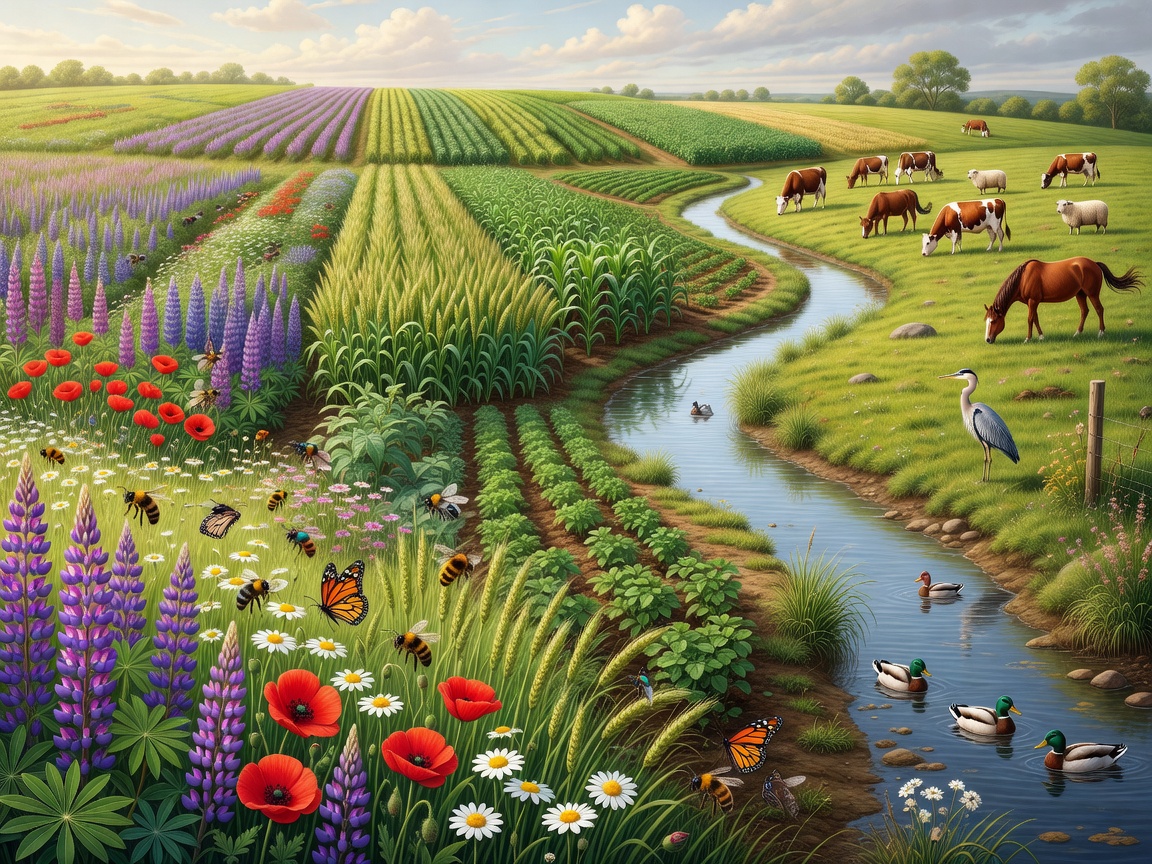
Organic farming’s narrower pesticide options, mixed rotations and reliance on biological processes can create better conditions for some plants, insects and soil organisms. Field margins, flowering crops and less intensive weed control may provide food and shelter. The benefit varies with landscape. An organic field in a simplified region does not become a complete ecosystem, while a conventional farm with substantial hedges, ponds and integrated pest management may support valuable habitat.
Species also respond differently. A practice helpful to pollinating insects may not address birds needing winter seed or wetlands. Certification provides a useful direction of travel, but biodiversity outcomes still depend on crop type, field size, surrounding habitat and actual farm management.
Synthetic pesticides fall, but risk needs detail
Organic rules substantially restrict synthetic pesticide use. That can reduce pressure from substances with unwanted effects on non-target species. Yet counting applications alone is a poor measure. Products differ in toxicity, persistence, dose and method of application. An authorised organic pesticide is not harmless because its source is natural.
Mechanical weed control provides a similar trade-off. It can replace herbicide, but repeated cultivation may use fuel, disturb soil and increase erosion risk on vulnerable ground. Cover crops, stale seedbeds and rotation can reduce that burden. The result depends less on a slogan than on the sequence of operations.
Climate impacts resist a single answer
Organic systems avoid the direct use of synthetic nitrogen fertiliser, whose manufacture requires substantial energy. Better use of legumes and organic matter can reduce that component. Soil carbon may increase under some practices, although gains depend on previous land use, climate, soil and how imported manure or compost is accounted for.
Lower yield can add climate cost per unit of food. Livestock emissions remain significant whether the feed is organic or conventional. Methane from ruminants is a biological process, not a synthetic-input issue. Longer growth periods or lower productivity can spread maintenance emissions across less output. Conversely, well-managed grazing may provide habitat and use land unsuitable for crops. The boundaries chosen for the assessment matter.
Nutrients can still escape
Replacing mineral fertiliser with manure does not remove nitrogen and phosphorus from the environmental equation. Nutrients may leach into water or escape as gases if supply and crop demand are poorly matched. Organic nutrient sources release at rates affected by temperature, moisture and biological activity, which can make timing difficult.
Rotations, cover crops, buffer strips and careful storage reduce losses in both organic and conventional systems. The organic model encourages several of these practices, but the final outcome remains management-specific. Water quality should be judged through nutrient balance, erosion and local catchment conditions, not through certification alone.
Land use is the central tension
If a system produces less food on the same area, extra land may be needed elsewhere unless diets, waste or demand change. Land conversion can carry severe climate and biodiversity costs. This is the main reason lower-impact-per-hectare findings cannot simply be translated into lower global impact.
The tension is not an argument for maximum yield at any cost. Very intensive production can damage soil, water and ecological resilience. It does mean that yield belongs in the calculation. Reducing food waste, using crops directly for human diets where suitable, and favouring less land-demanding foods can create room for lower-input farming.
Transport and season sit outside the label
Organic certification does not mean local, seasonal or transported by a low-emission route. A nearby conventional cabbage and an air-freighted organic soft fruit answer different environmental questions. Transport is sometimes smaller than production impacts, especially for high-impact foods, but aviation and heated growing can be important.
Packaging is separate too. Organic produce may be wrapped to maintain segregation and traceability, particularly where loose and conventional versions are sold together. Packaging can reduce damage and waste, but unnecessary material remains a cost. Compare the whole product rather than treating the word organic as a carbon label.
A defensible environmental choice
Look first at food type. Shifting part of a diet from high-impact animal products towards pulses and seasonal vegetables can matter more than changing certification within the same category. Then compare production setting: field-grown or heated, local season or long-distance supply, durable or highly perishable.
Organic can be a reasonable way to support farming with restricted synthetic inputs and a stronger emphasis on rotations and ecological processes. The uncertainty is not a reason to ignore those benefits. It is a reason to avoid the word “always”. Good environmental judgement keeps biodiversity, yield, climate, water and waste on the same page.